
ADVANCED MEDICAL CARE ASSISTANT COURSES
Increasing access and capability with existing workforce.
Hospitals and rural health organizations face the same problem: more patients than licensed hands. The Medical Care Assistant programs develop clinical support staff who safely perform an expanded set of delegated clinical tasks under Maine's physician delegating authority statutes — functioning as a physician's agent under medical director delegation and nursing supervision, with every skill individually trained, verified, and credentialed. The result: extended reach for physicians, nurses, and advanced practice providers, and an expanded clinical career pathway for the EMS workforce.
WHO IT’S FOR
Practitioners who hold an active EMT, AEMT, or Paramedic license, or who have successfully completed training at the EMT, AEMT, or Paramedic level. Individuals with prior military medical training and experience. Other practitioners considered based on training and experience.
HOW DELEGATION WORKS
Medical Care Assistant practice is based on the concept of delegation: the delegating practitioner can authorize services based on the provider's combined prior training and education. This includes all training and education, and does not depend on holding a current license because, by law, the Medical Care Assistant is “using” the delegating practitioner’s license. While the “medical assistant” is the delegated practice role most people are familiar with, the concept of delegation of practice, depending on the state, allows for much greater scope based on the licensed practitioner’s discretion.
Unlike a typical medical assistant course which trains individuals with little or no prior medical training, the Medical Care Assistant family of courses are intended to build on a baseline level of medical training to provide a much more expansive scope, similar to the early physician’s assistant who was typically a discharged military medic who assisted one (or a small group) of specific physicians, not the current independent or quasi-independent Master’s degree level physician associate of today.
To this end, the Hospital Medical Care Assistant course adds a set of hospital-oriented skills — wound closure, urinary catheter placement, and others — on top of the provider's baseline EMS training. People trained as an EMT, an AEMT, and a Paramedic will all take the same HMCA course and learn the same skills; in actual practice, the HMCA skill set layers onto each provider's primary EMS training. This is what distinguishes practice as an HMCA, HMCA II, or Advanced HMCA.
These courses do not create an independent scope of practice. A graduate cannot “hang a shingle” and practice on their own. They practice under the delegation of a licensed practitioner and can only use this scope of practice for that practitioner. Furthermore, in Maine, if they hold an active EMS license and are using that (that is, they are on an EMS call [emergency response, community paramedicine, interfacility transport, or non-emergency transport]) between dispatch and back in service, they cannot practice under delegated authority and cannot perform any skill that is outside of their EMS license scope of practice. Rules and laws vary state by state and it is the responsibility of the student to know and comply with applicable laws.
HOW THIS PROGRAM WORKS
Every program in the Medical Care Assistant family of courses follows a three-phase, mastery-based model:
Didactic training (~60 hours). Completed remotely through a learning management system. As each topic is mastered, the student becomes eligible for the associated lab session.
Laboratory (~30 hours). Hands-on skills work; primary labs run as three ten-hour days. Completing a lab topic unlocks the associated clinical rotation.
Clinical rotations (≈50–150 hours). As long as it takes — demonstration of mastery of specific skills at approved clinical sites. As each skill is mastered, the student is certified as competent in that skill. This certification is the basis of supervising-organization specific credentialing for actual clinical practice under delegation.
THE COURSES
HOSPITAL MEDICAL CARE ASSISTANT (HMCA)
This course is intended for individuals working in a hospital, clinic, or other healthcare facility. While practice may not be directly supervised, typically the delegating practitioner will be on-site. In some rural/remote settings, the delegating practitioner may be off-site and provide telehealth based supervision.
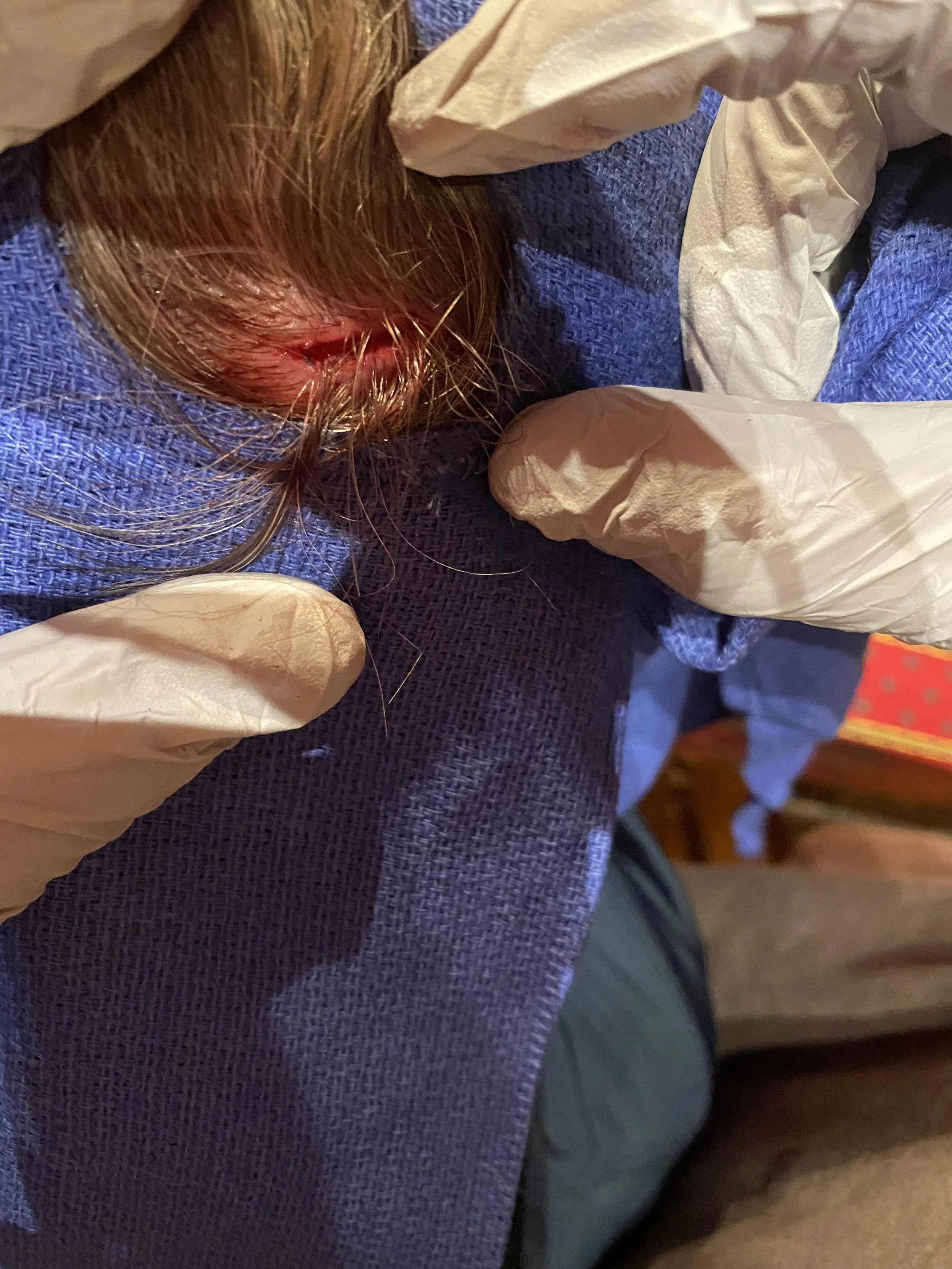
A single course teaching the full hospital-oriented delegated skill set beyond standard EMS education, including: wound closure (skin adhesive, tape, sutures, staples, and multi-layer closures); local anesthesia including local injection, field, digital, and tooth blocks; incision and drainage; embedded, ear, and nasal foreign body removal; epistaxis management including intranasal balloons; eye procedures (eyelid eversion, fluorescein, ophthalmic anesthesia, and irrigation including Morgan lens); splinting, elastic bandaging, and crutch fitting and teaching; subungual hematoma trephination; finger, patella, shoulder, and hip dislocation reduction; soft tissue POCUS image acquisition; urinary catheter placement and removal; specimen collection and point-of-care testing; and avulsed tooth management.
These skills are intended to be additive to the student’s baseline EMS training for actual practice.
RURAL / REMOTE HEALTH MEDICAL CARE ASSISTANT (RHMCA)
Delegated practice for rural, remote and critical access settings. Although these are primarily rural communities, healthcare deserts exist even in some large metropolitan areas and so the RHMCA practice model is relevant in those settings as well.
An 11-week online asynchronous course plus labs and clinical rotations, built for providers holding current or prior Advanced EMT or Paramedic licensure (any state, or National Registry certification). Prepares graduates for a remote delegated practice role extending clinician reach in communities where the rural health workforce is thinnest. A single course teaching the full outpatient / walk-in care delegated skill set beyond standard EMS education, including: wound closure (skin adhesive, tape, sutures, staples, and multi-layer closures); local anesthesia including local injection, field, digital, and tooth blocks; incision and drainage; embedded, ear, and nasal foreign body removal; epistaxis management including intranasal balloons; eye procedures (eyelid eversion, fluorescein, ophthalmic anesthesia, and irrigation including Morgan lens); splinting, elastic bandaging, and crutch fitting and teaching; subungual hematoma trephination; finger, and patella dislocation reduction; soft tissue POCUS image acquisition; urinary catheter placement and removal; and specimen collection and point-of-care testing.
THE COURSE AT A GLANCE
Mastery-based: ~60 hr LMS didactic + ~30 hr labs + 50–150 hr clinical rotations, with per-skill credentialing
Legal framework: Maine delegating authority statutes (32 MRS §3270-A and 32 MRS §2594-A);
Practice oversight by the delegating physician, AP, or NP and, in the healthcare facility setting, nursing leadership
Practice builds on the provider's primary EMS training
Labs delivered at your location or in Bangor, Maine
CME & CEH ACCREDITATION
Maine EMS and ACCME Accreditation Pending
PRICING
Contact us for pricing
DOWNLOADS
Bring This Course to Your Team
Courses are scheduled on demand and delivered at your location or in Bangor, Maine.