
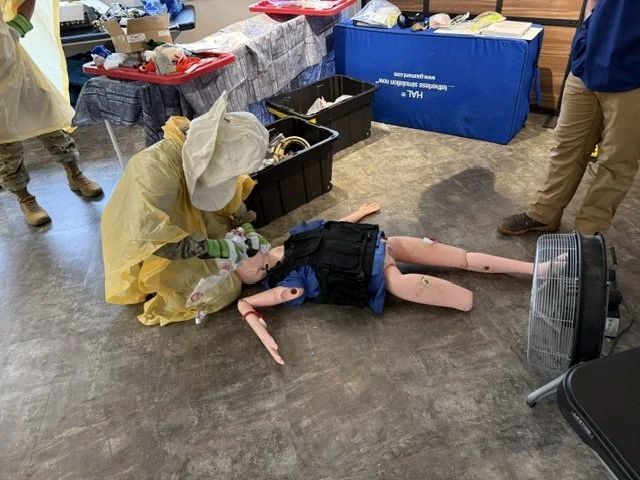
Applied Combat Lifesaver Skills
Turn combat lifesaver training into combat lifesaver capability.
Combat lifesavers are the bridge between self-aid and the medic. When seconds matter, the difference between having taken a course and being able to perform is measured in lives. Applied Combat Lifesaver Skills is one intensive day of supervised, hands-on repetition of the interventions that stop preventable battlefield death — taught on the equipment you actually carry.
WHO IT’S FOR
Service members and team personnel holding current TCCC Combat Lifesaver certification. or with equivalent training.
WHAT YOU’LL MASTER
Body substance isolation
One- and two-hand ratchet and windlass tourniquet application
Wound packing and pressure bandage application
Axillary, neck, and inguinal junctional hemorrhage control — improvised and commercial tools
Nasopharyngeal airway insertion; one- and two-person bag-valve-mask
Manual mechanical suction
Chest seal placement and needle chest decompression
Hypothermia prevention and treatment
Penetrating eye injury management and burn care
Splint application
Establishing casualty collection points
Patient evacuation
THE COURSE AT A GLANCE
1 day · 10 hours of in-person, hands-on lab sessions
Maximum 4:1 student-to-instructor ratio
Taught at your location or in Bangor, Maine
Participants receive self-guided training materials to maintain proficiency and, depending on enrollment tier, on-going training equipment and supplies.
SUGGESTED PAIRINGS
Maximize a single training trip by combining courses:
ACLSS + Combat POCUS: Upskill CLS providers to improve patient assessment and management
ACLSS+ RESONATE: A two day course that prepares the student for assessing and managing critical patients
ACLSS + Ventilator Management for Critical Patients: A two day course that prepares the student for ongoing management and transport of critically ill patients
CME & CEH ACCREDITATION
ACLSS is accredited for 10 hours of ACCME (AMA) Category 1 credit.
Maine EMS CEH accreditation pending.
PRICING
Our instructional philosophy is simple: you’re not buying a course, you’re buying a training program. When you take an F2L training, you get your initial training to achieve mastery and a comprehensive training program designed to maintain your skills once you leave the classroom.
Being able to practice your learning means that you need to have both a longitudinal training program and the equipment in hand to execute that program. Without that equipment, your skills will decay.
Given that, then only real question for any student in deciding what tier of each class to take is what equipment you need to execute the training plan after the class. The class tiers are set up as follows:
Tier 1 - The individual student who needs it all. Each student will leave the classroom with all of the training equipment necessary to perform all the longitudinal training exercises on their own in additional to the longitudinal training program content.
Tier 2 - The team who needs it all. If you work with a team that only needs a single set of training gear for a specific number of students, this is the tier for you. The courses are priced for a specific number of students sharing one set of training gear. If you would like a different ratio of students to sets of training gear, contact us for pricing.
Tier 3 - For those who already have it all. If you have the training gear already, this tier gives you the initial class and the longitudinal training program content; you bring your own training gear to the exercises.
ACLSS Pricing
Tier 1 - $4,000 / student
Tier 2 - Team of 5 students - $14,900 ($2,980 / student)
Tier 3 - $2,700 / student
DOWNLOADS
Bring This Course to Your Team
Courses are scheduled on demand and delivered at your location or in Bangor, Maine.